The Same 5 Water Financing Roadblocks Keep Coming Up Across 39 State Revolving Fund ‘Ask Me Anything’ Sessions with 800+ Attendees – Here’s How to Navigate Them
By Ashley Lucht, Director
I thought I’d spend these State Revolving Fund “Ask Me Anything” (AMA) sessions pointing water system operators toward answers. Instead, 39 AMA sessions and 810+ attendees later, I’ve learned that nearly every question gets the same honest response – “it depends” – and that the pattern underneath the questions is the real finding.
For the past year and a half, I’ve hosted bi-monthly AMA office hours on water infrastructure financing focusing on the Clean Water and Drinking Water State Revolving Funds (CWSRF and DWSRF, respectively), sponsored by the Environmental Finance Center Network through a grant from the U.S. EPA.
The format is simple: One SRF-related theme each session, and then whatever questions SRF program staff, technical assistance providers, and utility managers bring with them.
The same five themes surface repeatedly – no matter the participants’ role, experience with SRFs, or where they’re from. These five common areas of confusion closely align with moments where a water system hits a roadblock trying to pay for a project:
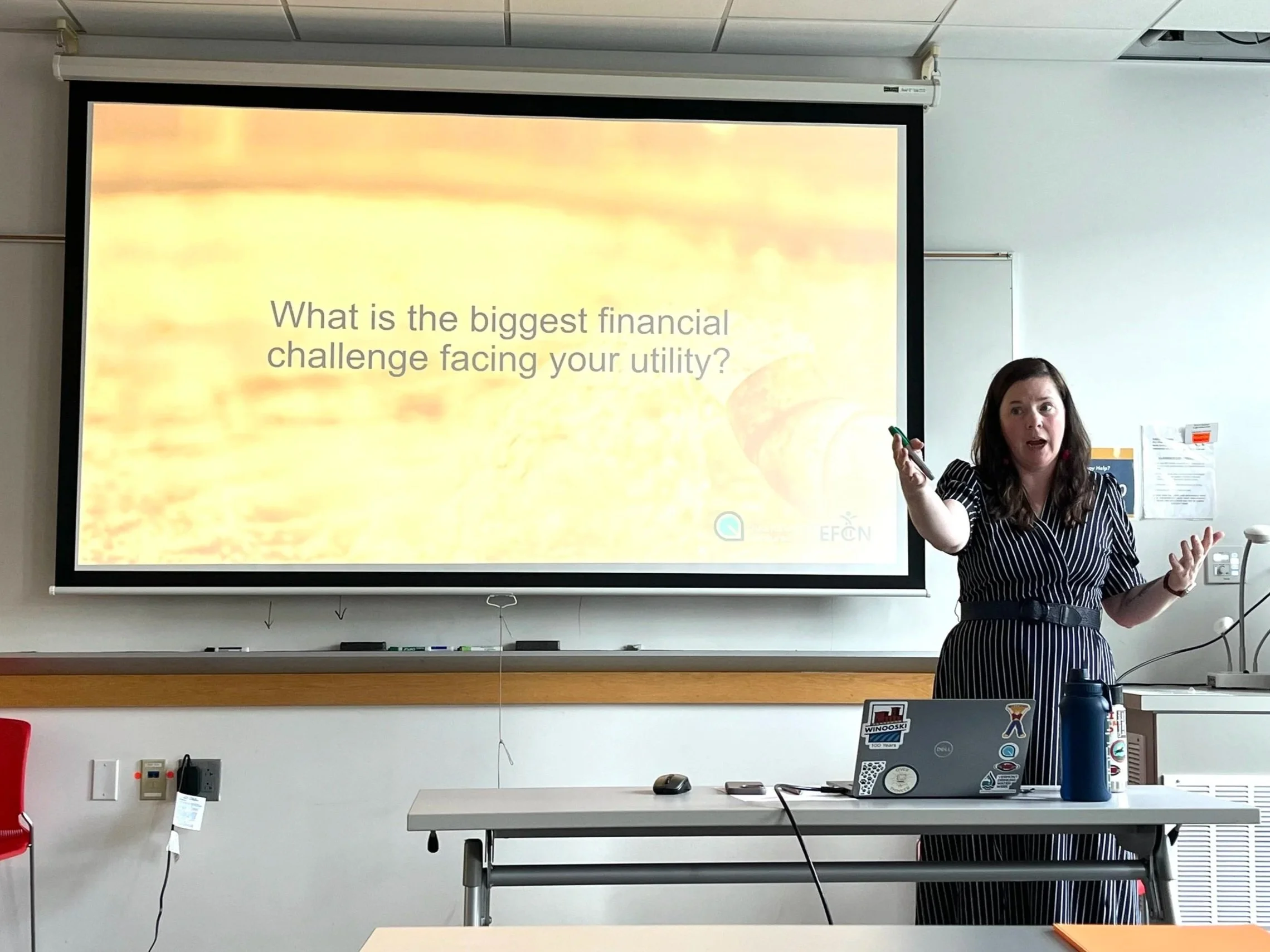
Ashley at a Financial Management for Water and Wastewater Utilities training in Maine in May 2026.
Can I even apply?
Can we survive the politics of saying yes?
What are we actually signing up for?
Can we survive the paperwork once we’re in?
Why is nobody handing down what they’ve learned?
What follows outlines the common sticking points and my condensed version of a response about how to handle each stage of the SRF project financing journey.
For those that don’t know, the SRFs – which are funded by federal, state, and revolved funds, and managed at the state level – provide below market financing for drinking water, wastewater, stormwater, and natural infrastructure projects. I’ve spent the past 20-odd years working with communities on infrastructure investment projects, including managing Vermont’s Drinking Water SRF Loan Fund, and I draw on that experience in these SRF AMA sessions.
1. “Is this eligible?” — and why the answer is almost always “it depends”
First stop: can I even apply? The single most common category of question is related to eligibility.
Attendees want to know whether the SRF can fund the project in front of them, and they’re rarely asking about a standard waterline replacement project. One attendee described a special district serving 21 people through 14 connections – municipally owned, but not a public water system, and therefore not SRF-eligible.
Attendees also asked about private wells and reverse-osmosis systems, privately owned supplies, new utility office buildings, parking lots at a treatment plant, lagoon closures with solar on top, even the type of seed used to restore a trench.
My answer usually starts with the same phrase regular attendees can now recite along with me: every state is different, and it depends.
Federal rules set the outer boundary of what the funds can pay for, but each program interprets and narrows that boundary to reflect its own needs and priorities. The recommendation is almost always to bring the specific project to the state program early, before significant effort has been put forth around an assumption that could turn out to be wrong.
2. How do I get elected officials and the public to accept a rate increase?
Say you clear the eligibility bar. The next hurdle is more political than technical: Can we manage the politics of saying yes?
This one comes up in nearly every session that touches on project financing, “City Council doesn’t want to raise rates, due to re-electability,” as one participant put it.
Another noted that utility operators tend to understand what the system needs, while the elected officials who are the decision makers and hold the purse strings are either unwilling to make the difficult decisions or don’t fully grasp the implications of delaying financial decisions. A recurring frustration is when operators raise the alarm, and elected officials either don’t listen or say it’s not in the budget.
The through-line in my answers is transparency.
Elected officials are responsible for protecting the public’s investment in infrastructure, public health, and the environment, and delay simply pushes costs and the risk of penalties into the future. It helps to make the invisible visible: For example, what is the cost of fixing a break time and time again versus replacing the line and paying for it with long-term financing? Some systems run creative public-education efforts; one favorite is a booth at a community event where residents divide a fixed pot of “money” across budget categories and quickly discover how little wiggle room there really is.
3. What are the SRF matching requirements? Is SRF “free money”?
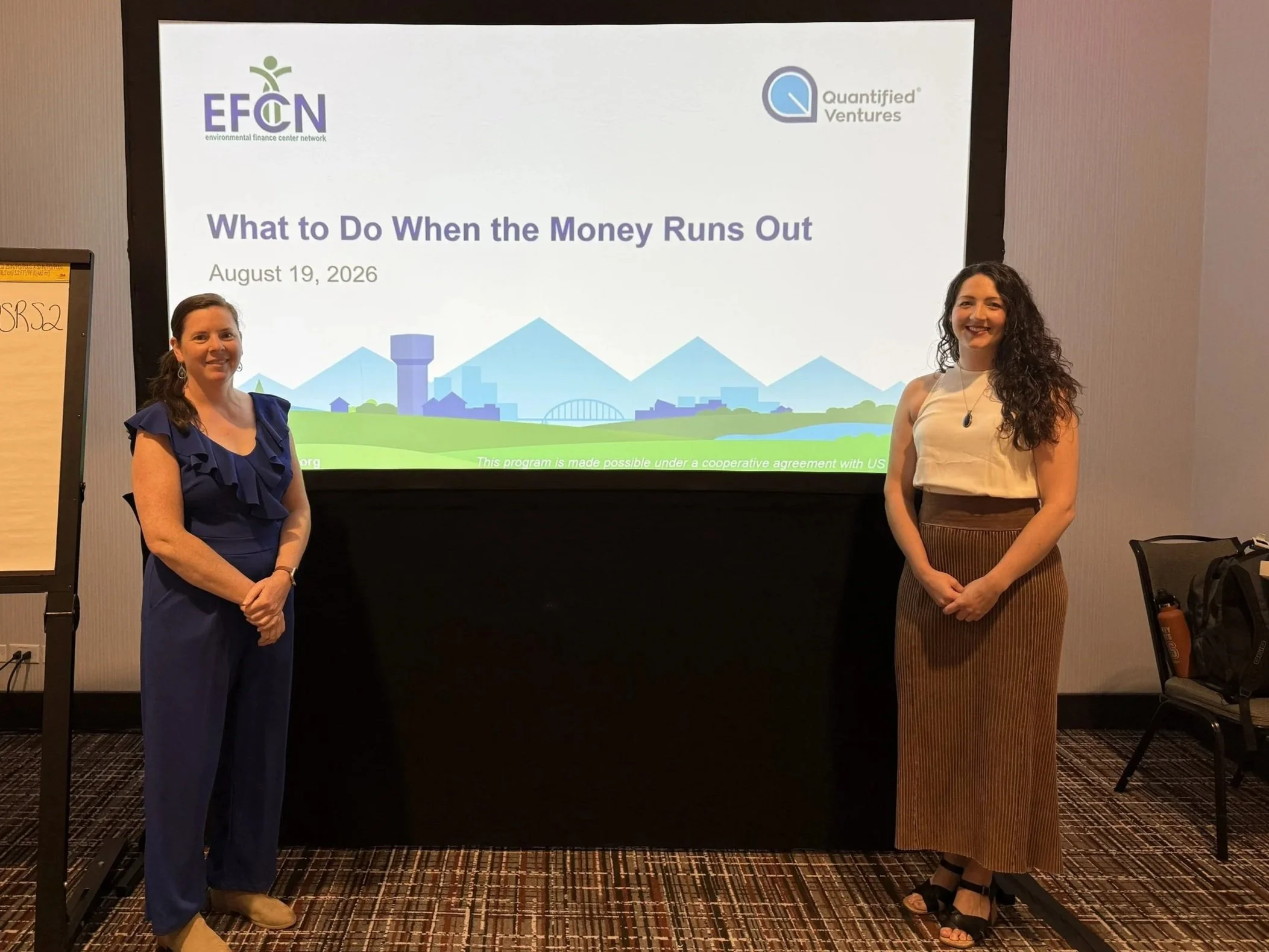
Ashley (left) and Jean Devlin (right) at the Rural Community Assistance Partnership (RCAP) National SRF Infrastructure Financing & Training Workshop in Colorado in August 2026.
Let’s say the rate increase passes. Now what are we actually signing up for? There’s persistent confusion about what SRF funding is and how it interacts with other programs.
Attendees ask for “creative” strategies to raise the match for an SRF loan (there is no match requirement!), whether SRF can serve as the non-federal match for a grant (it can!), and how funds change character once they revolve. This is one of the most misunderstood nuances in the program, and I’ve found that even some state staff aren’t clear on it: Once repayments come back into the fund, referred to as Tier II dollars, they lose their federal designation. For utilities that need a non-federal match for funding from other Federal sources, the SRF can be used as that match.
The flip side is that SRF is not free, which experienced participants are quick to raise in the chat. It’s a low-interest (subsidized) loan program that carries real accountability — permitting, bidding, procurement requirements, federal compliance obligations, and repayment. The honest framing is somewhere in the middle. Not free, but among the most affordable and durable capital a small utility can access.
4. How do equivalency and federal cross-cutters actually work?
You’ve got the money and the political support. Now can we survive the paperwork?
Equivalency and federal cross-cutting requirements like Architecture and Engineering (A/E) procurement (CWSRF-only), Build America Buy America (BABA), Davis-Bacon, Single Audit, Signage, Telecom, Disadvantaged Business Enterprise (DBE), and American Iron & Steel (AIS) generate the most discussion in almost any session.
Attendees ask whether Davis-Bacon flows down to subcontractors (it does, all the way down), how SRF programs can target projects for equivalency instead of applying them to all funded projects, and why a CWSRF borrower should procure an engineer before they even apply for funding.
I would love to see SRF programs apply equivalency requirements on one or two large projects that will actually reach construction in a funding cycle, rather than applying them to every borrower and project. The practical advice that comes up regularly from participants themselves is to start collecting your AIS and BABA documentation early, because it always takes longer than you expect.
Crosscutters 101: These are federal requirements that apply to any project that receives federal money, even when the requirement seems unrelated to water. SRF programs are required to apply these requirements to the amount of project funds equal to (hence “equivalency”) the amount of federal grant (base capitalization, Bipartisan Infrastructure Law-general supplemental, BIL-lead service line, BIL-emerging contaminant). Borrowers will agree to comply and demonstrate compliance with these requirements typically when the loan agreement is executed, when contracts are executed, or when reimbursements are requested.
5. I’m brand new to this. Where do I even start?
If this is your first time doing any of this, you’re often learning it from scratch. Nobody’s handing down a clear roadmap to follow in each and every situation.
A number of AMA attendees are new to SRF and sometimes to water and wastewater utility management entirely. “I had to Google what IUP [Intended Use Plan] stood for,” one wrote, asking whether a glossary or acronym cheat sheet exists.
Another, new to the job and tasked with seeking project funding, asked plainly: “I have no background in water… Where should I start?”
Others simply appreciated a session that began at the beginning instead of assuming prior knowledge.
This is why I love doing these sessions. The SRF workforce ranges from 40-year veteran operators to those three weeks into a role they haven’t been trained for, and the program does not come with an easy button or a simple “how-to manual.” For newbies, know that the acronyms do eventually click, your state program staff genuinely want to help, and showing up to sessions like these is one of the fastest ways to build fluency. Even after 20+ years of speaking SRF, I frequently learn something new each time I prepare for a session.
The pattern underneath the questions
None of these questions have a single clean answer, and that’s the point. “Every state is different, and it depends” is a running joke in these office hours, and it’s also the truth about a federal program administered 102 different ways (yes, 102! One each for DWSRF and CWSRF, in every state and Puerto Rico).
These five recurring themes reveal a design challenge more than a workforce knowledge problem. Whether I’m speaking with water sector rookies or veterans, large system operators or small, urban or rural, the same roadblocks pop up. This is a workforce diligently working to serve communities without always having the reference material they need to deliver. That’s the gap these sessions fill.
If you’re stuck on any of these five questions, you’re in good company — alongside hundreds of AMA attendees. Bring your question up in the next virtual session, or reach out to me directly!