
The End of Climate Finance as Usual: QV Looks Ahead to 2026
By Tee Thomas
In early 2025, it felt like the air went out of the room.
Federal funding got wobbly. Language like “climate” and “equity” quietly started to disappear from agency websites. Whole sectors hit pause, unsure whether to rebrand, retreat, or simply wait it out. Conferences were full of forced optimism and sidelong glances. People glanced at each other, as if to say, “Are we… still doing this?”
But as 2025 comes to a close, the QV team is feeling more energized than ever. All we see are opportunities. Everywhere.
One thing I love about this team is we’ve always been drawn to what feels too hard, too risky, or too messy. QVers are inherently disrupters at our core. Our company has been around for 12 years and has been through a few turns of these political carousels before.
Of course, the need to invest in climate and water doesn’t simply disappear because of an election or a change in political leadership. But we have seen a rapid evolution, with the most interesting, practical innovations emerging locally from the places closest to land, water, food, and community infrastructure.
Let’s take a closer look at a few of our emerging transactions and partnerships to demonstrate where the field of climate finance innovation is heading.
Each of these real-world examples asks a variant of the same question: If the old way is losing momentum, what does it take to build something faster, simpler, and more impactful — right now? Here’s what that looks like in practice.
The Freshwater Trust: Data as a Price Signal, Not a Report
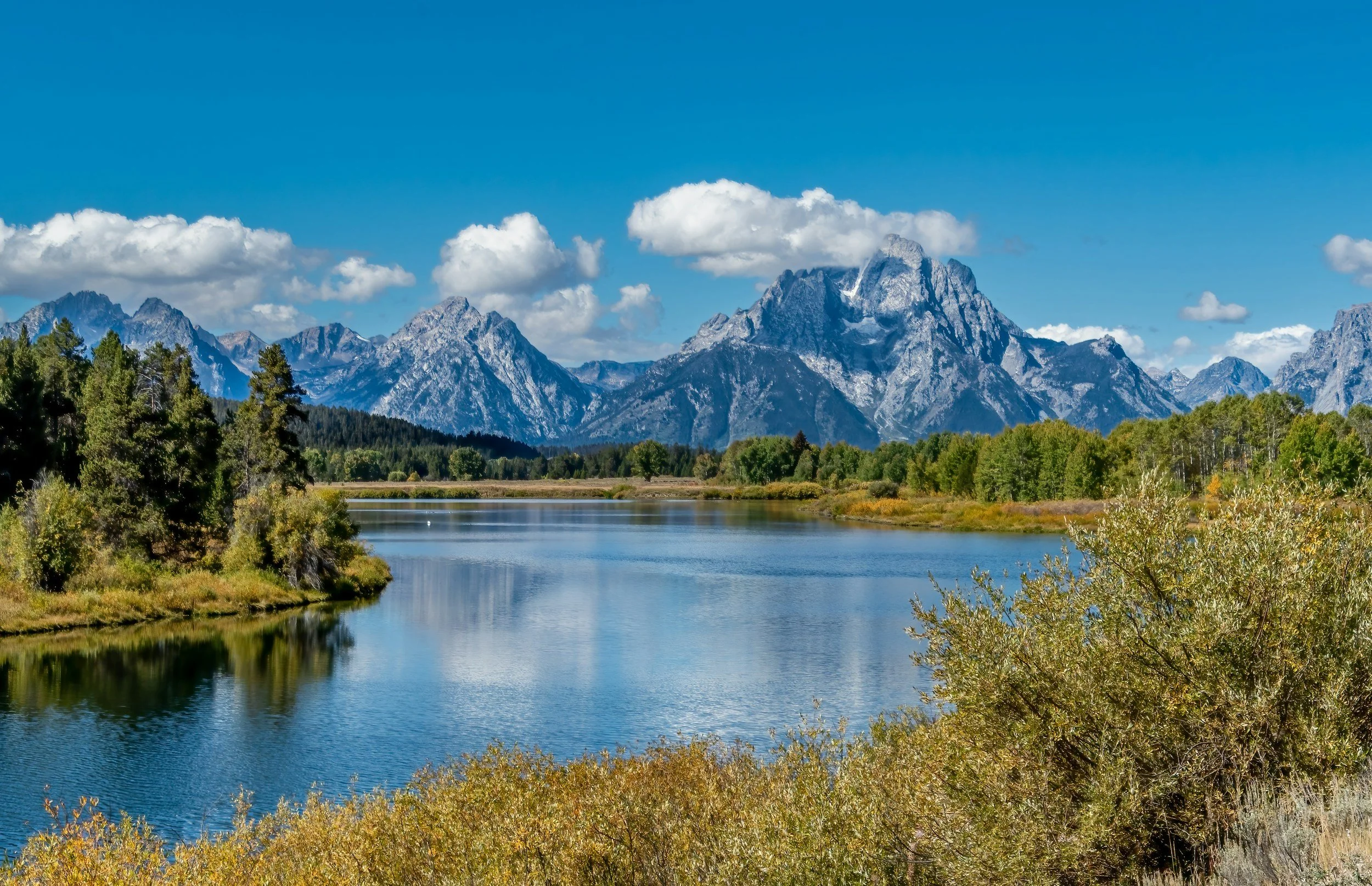
Oxbow Bend on the Snake River in Wyoming. Photo by Stephen Crane.
If you want a window into the future of agricultural and water-quality finance, look at what The Freshwater Trust (TFT) is doing in the Snake River watershed.
Most conservation programs still operate on a first-come, first-served basis, or around diffuse program priorities. TFT flipped that model by asking a different question:
What if data told us exactly which projects get us to a water-quality goal for the lowest total cost?
Using its BasinScout® analytics platform, TFT assessed 36,000 irrigated fields — nearly 300,000 acres — and identified the specific 2,000 projects that would remove enough phosphorus to meet regional target loads. Then they put a price tag on it: $210 million for the whole watershed.
By targeting 20% of the most impactful parts of the watershed, they’ll produce 80% of the benefit. This is not a guess; it’s a calculation. That clarity lets you do something unprecedented: Design finance around outcomes instead of program rules.
QV has partnered with TFT to design the financing vehicle to make this innovation possible in the Snake River. Inovative financing makes everything move faster:
23 irrigation upgrades completed in a single year
More than 115 projects queued
Local irrigation suppliers mobilized as recruitment engines
A centralized funding vehicle (Irrigation Incentives, LLC) aggregating federal, state, private, and utility dollars
A $5 million line of credit advancing payments so producers aren’t carrying costs
This is not conservation as usual. It’s infrastructure finance for agriculture — rooted in precision analytics, delivered through trusted local supply chains, and paid back through verified outcomes.
2026 will be the year this model scales into multiple basins across the West. It’s also the year data starts being used not just to describe watersheds, but to underwrite them.
Great Outdoors Foundation: Financing the Agricultural Transition at the Speed of Water

Sunset over a field on a farm in Iowa. Photo by Anival Torres.
The Great Outdoors Foundation (GOF) has masterfully and consistently been a farmer-first conservation organization where it’s needed most — in the heart of Iowa’s prime agricultural landscape. GOF raises around $15 million per year and those dollars catalyze another $150 million in other water quality funds.
In 2025, QV has worked with GOF’s Conservation Acceleration Fund (CAF) to design interim financing that’s deceptively simple — front-loading capital so projects can move forward now, while myriad other grant and donation funding flows in during the next 2–5 years.
This solved one of the field’s biggest bottlenecks — slow, staggered grant cycles — and created a batch-and-build model that removes friction for landowners and installs practices at scale.
Moving into 2026, QV and GOF are setting our sights higher. We plan to build the bridge between conservation and full regenerative agriculture transitions through better market access and diversified revenue streams for farmers.
Right now, water-quality challenges in the Midwest are symptoms of an agricultural system under pressure. And farmers know it. Many want to shift practices but can’t wait years for programs to align. Their job is to farm and help provide food and fuel.
Our ambitious goal in 2026 is to create the ecosystem that helps farmers do that more profitably, in a way that also makes us all healthier and more economically stable. In short, GOF and QV are working to answer the question: What if Iowa could meet water quality goals not through regulation — but through finance?
This isn’t far-fetched. It’s simply the next evolution of what GOF has already built.
And it pushes the sector toward a future where regenerative agricultural change is not a side project — it’s the core strategy for improving water quality, building resilience, and supporting farm viability.
Montgomery County Green Bank: A Resilience Market Ready to Emerge
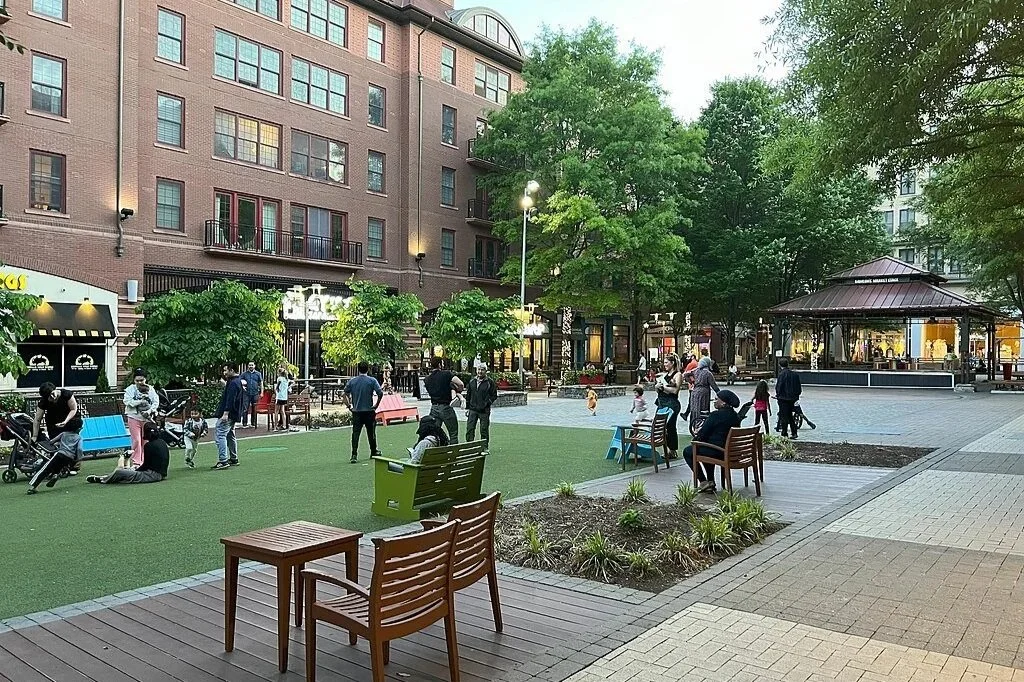
Rockville Town Square in Montgomery County, Maryland. Photo via Wikimedia Commons
If TFT represents precision data and GOF represents accelerated conservation and ag transition, then Montgomery County Green Bank (MCGB) represents the next frontier: financing resilience for communities, farms, and municipalities alike.
QV is supporting MCGB through the early design stages of a municipal resilience finance program. MCGB’s role — as a trusted local finance institution — is to be the market maker for resilience by designing products that braid efficiency, water resilience, energy, and municipal infrastructure upgrades into a coherent suite that communities can actually use.
Building upon their initial resilience success with the Resilience Dedicated Fund, MCGB’s resilience program “Protecting the Path to Net-Zero” has set an ambitious county-level entity vision built and crafted through deep engagement with a subset of pilot communities in the county.
This is a “coming soon” that matters. In 2026, MCGB’s resilience products could become a national model for how green banks catalyze local investment in agriculture, water, and community systems — not as separate programs, but as a single resilience stack.
What These 3 Initiatives Have in Common
It might not be obvious at first glance, but TFT, GOF, and MCGB are each working on a different part of the same puzzle: agriculture, water systems, community resilience, local supply chains, and tying them together with bold new financing models.
Together, they reveal the next chapter of climate and water finance. The system is reorganizing around speed, scale, and measurable outcomes.
The story of early 2025 was that everything was “over.”
But the real story — the one unfolding across fields, watersheds, and communities — is that the center of gravity is shifting.
Toward speed.
Toward measurable outcomes.
Toward people and institutions who refuse to wait their turn.
In 2026 and beyond, these forces will shape climate and water finance, developing new, innovative, and repeatable solutions that deliver climate outcomes and community benefits.
