
Policy shifts are turning visitor-generated revenue into a financing opportunity for community priorities
By Cailin O’Brien-Feeney, Senior Director
Gas taxes help pay for roads. Airline fees help pay for airports and air traffic control. Imagine if instead those dollars were required to be spent primarily on advertising campaigns encouraging people to drive and fly more. Meanwhile, the roads, bridges, runways, and infrastructure that make those trips possible were left scrambling for funding.
This may sound like a fictional scenario, yet for decades, this is effectively how tourism has worked in many communities across the United States – especially those reliant on outdoor recreation. When you spend a night in a hotel near a tourist destination, the lodging tax you pay is often required to be primarily spent on advertising, marketing, and tourist venues to attract more visitors, instead of on improving local infrastructure and public services.
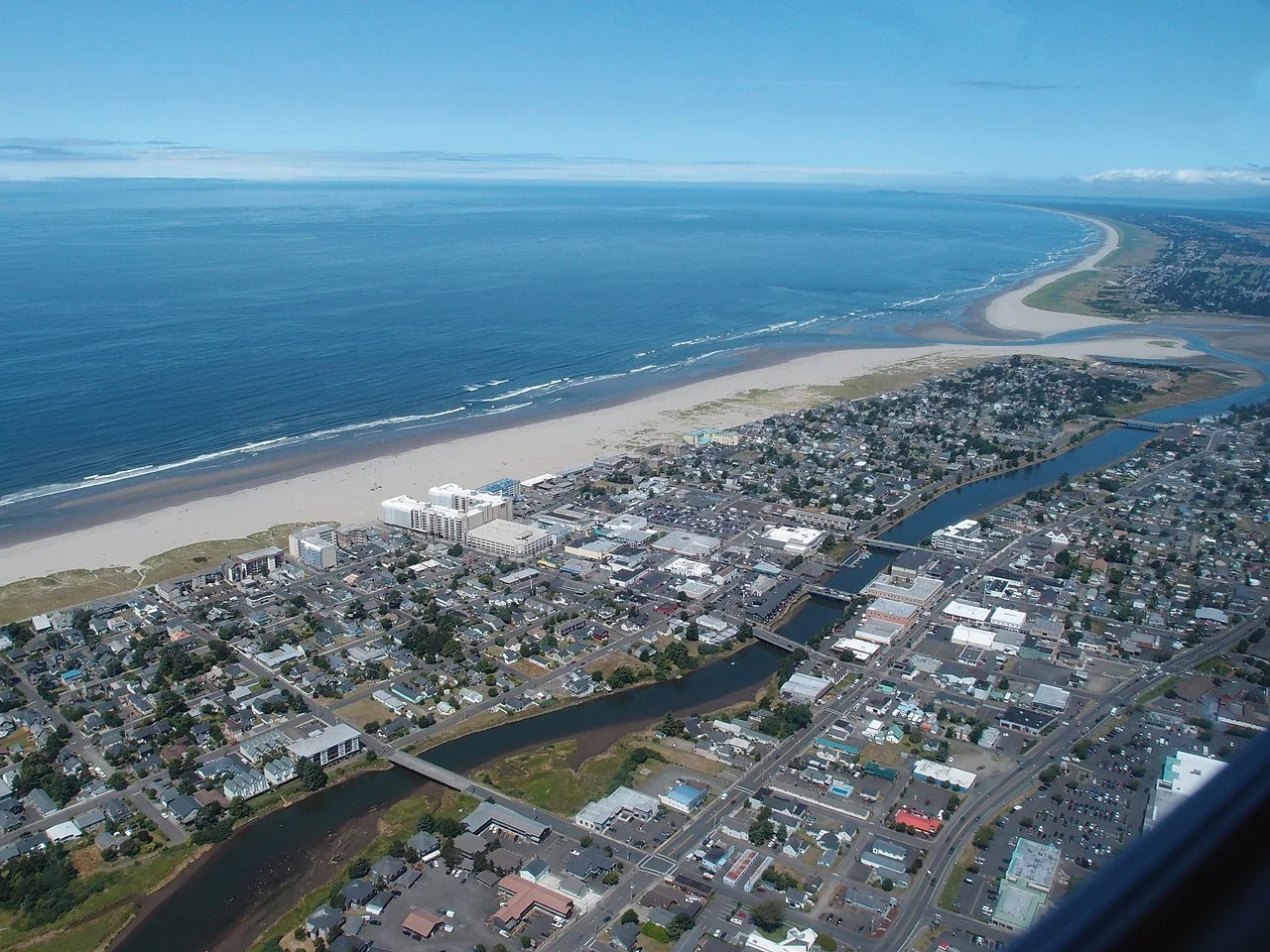
Aerial view of Seaside, Oregon. Photo by Dieter F, via Panoramio and Wikimedia Commons.
Seaside, Oregon, lies 90 minutes west of Portland, with stunning views of the Pacific coastline. The town is home to less than 8,000 full-time residents, but each year it welcomes approximately 2 million overnight visitors.
Those visitors pay a lodging tax that, until recently, was required by state law to be mostly spent on promoting more tourism. Not on community priorities and critical infrastructure like roads, bridges, water systems, police, fire, and EMS.
Steve Wright, the mayor of Seaside, was one of many local leaders in Oregon to support legislation this year designed to provide communities with additional flexibility on how lodging tax funds are spent. As Mayor Wright noted in his testimony to Oregon legislators, "Today, the question is no longer how to bring visitors to Oregon. The question is how to sustain the communities that make those visits possible."
Community Resources Stretched Thin
In tourist destination communities across the country, public lands are underfunded and showing the strain—workforce housing is increasingly out of reach, and public services are stretched thin.
For decades, the money visitors generate has been routed right back into attracting more tourism—advertising, events, and promotions designed to drive still more demand. That made sense when demand was the central challenge. For many communities, it no longer is. The pressing challenge now is funding the housing, infrastructure, public services, and community resilience on which tourism depends. This issue is particularly prevalent in outdoor recreation gateway communities, which historically have not used tourism dollars to fund the trails, waterways, or public lands on which their economy depends.
In recent years, many state, local, and regional tourism entities have begun shifting from destination marketing toward destination management, showing real leadership by investing in place-based programs, infrastructure, and visitor stewardship.
Where I live, the Bend Sustainability Fund is one leading example, reinvesting visitor-generated lodging tax revenue into community-serving priorities such as river access, trail and trailhead improvements, habitat restoration, and accessibility.
These efforts are meaningful. They're also nowhere near sufficient. Outdoor recreation continues to grow, and in many destination communities, workers can't afford housing and the cost of living, trails close from overuse or lack of maintenance, and public services are stretched beyond capacity.
State policy is now shifting quickly: Hawai’i signed its Green Fee in May 2025, Colorado expanded county lodging-tax authority that same month, and Oregon recently passed two major lodging-tax reform bills. Together, these changes show that visitor-generated revenue can be used for far more than promotion, creating new opportunities to address the community needs associated with tourism.
Using lodging tax revenue differently is one breakthrough. At Quantified Ventures, we see an even larger opportunity to structure and scale that revenue so it can unlock new financing pathways for conservation, resilience, community infrastructure, and recreation.
Done right, these revenues can provide the reliable repayment streams that unlock the blended financing many projects have historically lacked. We know this from experience, as some of the most significant outdoor economy projects QV has worked on in Ohio, Vermont, Washington state, and beyond have been able to launch and scale through a mix of philanthropic, private, and public dollars.
Mapping the Path to Recurring Revenue

Every year, projects that would genuinely improve people's lives — trails, resilience infrastructure, workforce housing — fail to get off the ground. Not because they're bad ideas. Not because they lack potential. Because they can't prove a repayment stream.
The pattern is familiar. Recreation, conservation, and community infrastructure projects deliver real public value, but rarely a direct revenue stream for the developer. Grants and philanthropic dollars help, but they're episodic — they can't build reserves, backstop debt, or give a project the staying power to scale.
User fees could theoretically fill the gap, but in many places they're politically difficult, operationally cumbersome, or in tension with access and equity goals the project is meant to serve. This leads to the same question every serious project must eventually answer when it comes to financing: Is there a recurring, place-based revenue source durable enough to actually build on?
Tourism’s Missing Link to Project Financing
Visitor-generated revenue is one of the strongest missing links for projects that serve destination economies.
Tourism-related taxes are one of the few recurring, place-based revenue streams connected to the assets and systems on which tourism depends – the trails, landscapes, and other amenities visitors come for, supported by the community housing, workforce, public safety, and infrastructure that make those visits possible.
The bigger question is whether that revenue can do more than fill annual budget holes. Can it shift to become the backbone for more durable financial tools? That is where the real opportunity lives.
States Advance Policy Solutions
States and communities are showing that this shift is no longer theoretical.
There is not a one-size-fits all legislative solution. Flexibility is key, with policies tailored to local needs and priorities. Broadly, three types of policy approaches are gaining traction: visitor tax increases to provide new dedicated funding (Hawai’i and Oregon); more flexible spending authority (Colorado and Oregon); and more resilient funding models (Wyoming).
In Colorado, lawmakers expanded allowable uses of county lodging tax revenue and local marketing district taxes to include housing and childcare for the tourism-related workforce, public infrastructure, and public safety measures such as fire protection and EMS. Local examples, such as Chaffee County and Grand County, show how that new flexibility is already being used to support housing, childcare, and other community priorities.
In Hawai’i, a Green Fee signed into law in 2025 increased the transient accommodations tax and is projected by the Governor’s office to generate about $100 million annually for environmental stewardship, hazard mitigation, and climate and infrastructure resilience.
In Oregon, HB4148 broadens local flexibility for transient lodging tax use, while HB4134 increases the state transient lodging tax and dedicates the increase to wildlife and related stewardship purposes beginning in 2027. Both measures went into effect in June 2026.
In Wyoming, the Outdoor Recreation and Tourism Trust Fund points to another important evolution: not just broader spending authority, but the creation of more durable funding architecture tied to tourism and outdoor recreation.
These are just a few recent examples, and while they differ in design and use of funds, all point in the same direction: Visitor-generated revenue is increasingly a tool for public-purpose investment.
The Real Opportunity: New Financing Pathways

Spending authority enables tourism revenue to pay for projects directly. Structuring it as a repayment stream lets it be the financing for much larger projects. Without that structure, expanded authority risks dissolving into annual budgets – good for next year’s projects, but not a financing tool.
The real breakthrough comes when recurring tourism revenue stops being an annual line item and starts being a backbone for resilience reserves, revolving funds, stewardship vehicles, and repayment-backed capital. That's the difference between a policy win and lasting impact at scale.
Many important projects have long struggled to attract financing because they lack an obvious repayment source. At QV, we help project partners evaluate financing readiness, test repayment pathways, align revenue with outcomes, and design blended capital stacks that turn policy flexibility into durable financial architecture. At Mount St. Helens, that included building a flexible cash-flow model and financing roadmap that leverages $3 million in additional annual revenue derived from upgrades to a lodge and education center for long-term operations and debt service.
Most partners we work with have the policy authority but not the financial architecture to use it. That's exactly the gap we work in — and visitor-generated revenue is one of the most promising tools we've seen.
Financing Regenerative Tourism
Tourism that extracts value from a place without reinvesting in it isn't sustainable. The revenue it generates must help sustain the people, places, and systems on which the tourism industry relies.
The policy solution examples highlighted above are just a few of the many states and communities showing that visitor-generated revenue can support far more than additional tourism promotion. More importantly, they suggest that a new financing lane is emerging for projects that have long struggled to find dependable repayment sources.
If you are a local government, state agency, destination leader, or project developer wondering whether your tourism revenue could do more – it can. The policy momentum is real; the next step is structuring and scaling it.
Let's talk about what your revenue could create.

